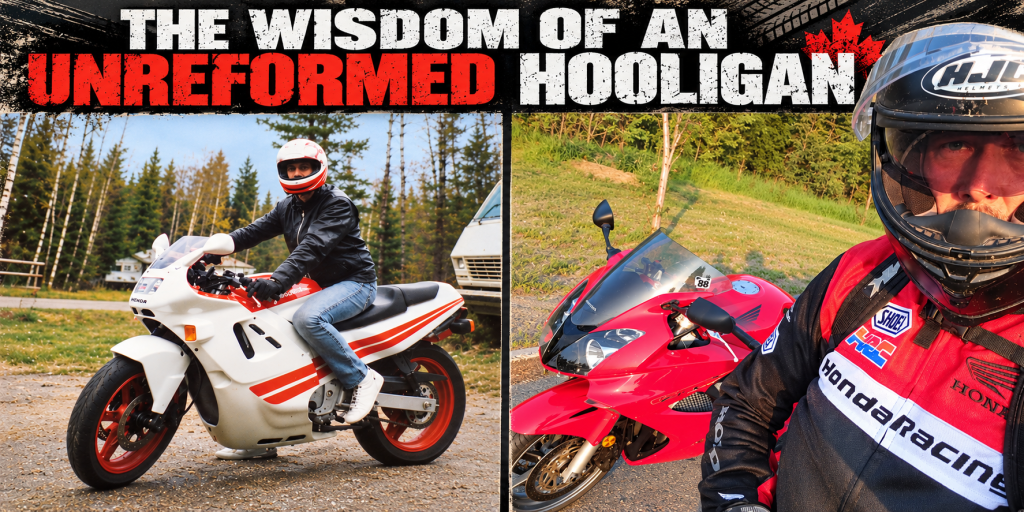
Every once in a while, Carla and I will be driving somewhere and we’ll see some young guy on a sport bike doing something stupid. Maybe he’s pulling a wheelie through an intersection, showing off, or riding like he’s got absolutely no concern for his own survival.
Carla will shake her head and say, “What an idiot.”
And I’ll start to agree with her. Yeah, what an idiot.
But then I catch myself.
“Don’t forget, honey. I used to do that kind of stuff all the time.”
And it’s true. I did. I’ve done things on motorcycles that would make most sensible people question whether I should have been allowed to operate a toaster, let alone a 150-horsepower sport bike.
Some of those things were incredibly stupid. Some were dangerous. And some were both, but holy shit, were they fun.
Now, before somebody gets all worked up, I’m not saying it’s okay to go ripping through intersections on one wheel. I’m not suggesting we should give the kid a medal for his impressive disregard for personal safety.
I’m just saying I understand him.
And there’s a difference.
I read something the other night that stuck with me. I don’t remember exactly how it was worded or who said it, but it was something along the lines of, “He’s out here making adult-sized decisions with a youth-sized frontal lobe.”
I laughed when I read it, but the more I thought about it, the more sense it made.
We expect young people to make good decisions, but sometimes we forget what it was like to be young ourselves.
I remember being that age. I remember the adrenaline, the excitement, and the feeling that I was pretty much indestructible.
And I remember making decisions that, looking back now, were questionable at best.
The funny thing is, I didn’t think I was being stupid at the time. Well, okay, sometimes I knew perfectly well I was being stupid. But that didn’t necessarily stop me.
And that’s where I think we sometimes get a little unfair as we get older.
We look at somebody who’s twenty years old and judge their decisions using fifty or sixty years of experience.
Well, that’s hardly a fair fight, is it?
I’ve had decades to learn from my mistakes. I’ve had close calls, embarrassing moments, and more than a few situations where the only reasonable explanation for the outcome was dumb luck.
And somehow, after all that, I’m supposed to look at a young guy doing something reckless and act like I’ve always known better?
Come on.
But this isn’t really about motorcycles.
It’s about something I’ve been thinking about more and more as I get older. The difference between understanding somebody’s behaviour and condoning it.
Those two things seem to get mixed up a lot.
If you say you understand why somebody did something, people sometimes assume you’re defending them.
You’re not necessarily.
I can understand why that kid wants to show off on his motorcycle without thinking it’s a particularly brilliant idea.
I don’t have to approve of what he’s doing to remember what it felt like to be him.
And really, that’s the point.
We’ve all made mistakes. We’ve all done stupid things, taken chances we probably shouldn’t have, and occasionally gotten away with things that could have ended very differently.
The difference is, when we look back on our own mistakes, we remember what we were thinking at the time. When we see somebody else making one, all we see is the mistake.
And sometimes we forget that there’s a whole person behind it.
Maybe that’s one of the benefits of getting older. Not necessarily becoming smarter, although I’d like to think I’ve picked up a thing or two along the way, but becoming a little less certain that we know everything about somebody based on one moment of their life.
I’ve had enough moments of my own that I wouldn’t particularly want to be judged by.
So when I see that young guy on his motorcycle, I might still shake my head. I might even call him an idiot.
But I also remember being him.
I remember the excitement. I remember the confidence. I remember the sheer joy of doing something ridiculous just because I could.
And I hope he has his fun, doesn’t hurt anybody, and lives long enough to look back on those moments with the same mixture of embarrassment and amusement that I do.
Godspeed, my son.
Because I used to do that kind of stuff all the time.
Of course, when I say “used to,” I might mean last Thursday.