I have decided that I will share the lyrics to our music here, because let’s be honest the words are most of the fun haha. This song is inspired by one of Carlas ongoing jokes/threats. She’s pretty easy going but don’t ever, ever hurt the dog…
*Note – links at the end to hear the song on Spotify or Apple Music 🙂
Intro – I’m pretty easy-going, takes a lot to get me hot. Most things just ain’t worth the risk of getting caught.
Verse 1 – You can steal my lunch from my fridge Cut me off in traffic, hit the ditch Call me every name you know I’ll just smile and let it go
Chorus – But if you hurt my dog… They’ll put your face on the evening news. Search the woods and hunt for clues. Drag the river, check your phone, Ask the neighbors when you were last at home. Preacher says the devil caught ya, Mrs. Murphy thinks the aliens gotcha. I’ll just say I don’t know where you’re at… And you’ll just be a strange smell in the attic.
Verse 2 – Spread your rumors, paint me mean Try your best to wreck my scene Go ahead, wreck my reputation I won’t need your explanation Chorus – But if you hurt my dog… They’ll put your face on the evening news. Search the woods and hunt for clues. Drag the river, check your phone, Ask the neighbors when you were last at home. Preacher says the devil caught ya, Mrs. Murphy thinks the aliens gotcha. I’ll just say I don’t know where you’re at… And you’ll just be a strange smell in the attic. Verse 3 – Take my man, I’ll wave goodbye Spend my cash and tell your lies Break my heart, I’ll let it be Some things don’t mean much to me Final Chorus – But if you hurt my dog… They’ll put your face on the evening news. Search the woods and hunt for clues. Drag the river, check your phone, Ask the neighbors when you were last at home. Preacher says the devil caught ya, Mrs. Murphy thinks the aliens gotcha. I’ll just say I don’t know where you’re at… And you’ll just be a strange smell in the attic.
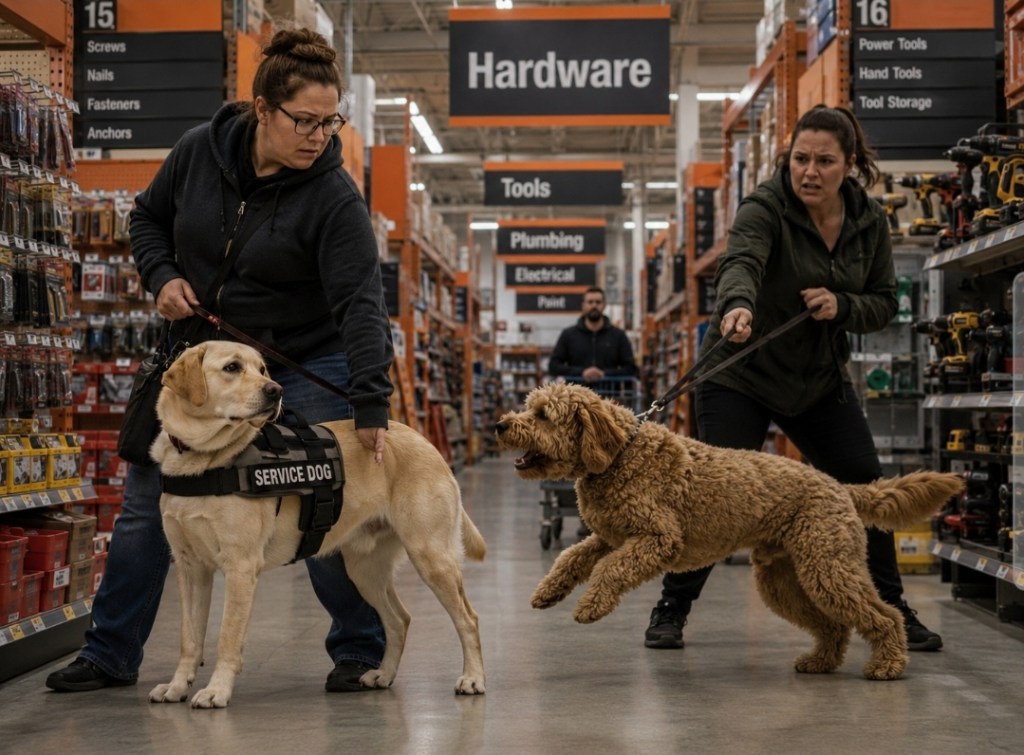
Ok folks, sit down, buckle up and grab a coffee. There have been some posts recently that are so full of misinformation that one has to shake their head, so lets try and clarify a few things. There is a growing misunderstanding in Canada – and especially in British Columbia – about the difference between emotional support dogs, therapy dogs, and legitimate certified service dogs. For many people, a dog is simply a beloved pet. But for someone who depends on a true service dog, that animal is not a luxury, a comfort item, or a trend. It is independence. It is safety. It is mobility. It is freedom. As someone who understands what a real service dog means to its handler, I think the public often fails to realize how devastating it can be when a poorly trained pet, fake “service dog,” or uncontrolled animal interferes with a working dog team. A guide dog leading a blind handler through traffic is not just “a dog allowed in a store.” That dog is functioning as that person’s eyes. A seizure-alert dog may be the only warning someone receives before collapsing. A mobility assistance dog may help someone stand, retrieve medication, or open doors. These dogs are highly trained medical tools wrapped in fur. And when something happens to one of these animals, the consequences are life-changing. The Three Types of Dogs People Often Confuse: 1. Service Dogs (Including Guide Dogs) In British Columbia, guide dogs and service dogs are legally recognized under the Guide Dog and Service Dog Act. These dogs are specifically trained to perform tasks directly related to a person’s disability. Examples include: Seeing-eye dogs for blind or visually impaired handlers Seizure-alert dogs Hearing dogs Mobility assistance dogs Psychiatric service dogs trained to perform specific tasks A real service dog is not simply comforting its owner. It is trained to actively work. In B.C., certification can occur through accredited schools or by passing a provincial public safety assessment. The province also recognizes dogs trained through accredited organizations such as Assistance Dogs International (ADI) and the International Guide Dog Federation (IGDF). Under B.C. law, certified service dogs have public access rights and tenancy protections. Businesses generally cannot deny entry to legitimate service dog teams. 2. Therapy Dogs Therapy dogs are very different. These dogs are usually brought into hospitals, schools, care homes, or crisis situations to provide comfort to other people. The dog is helping the public – not specifically assisting its handler with a disability. A therapy dog may be calm, gentle, and well-trained, but therapy dogs do not have the same legal public access rights as certified service dogs in British Columbia. A therapy dog cannot simply enter any store or restaurant because it wears a vest. 3. Emotional Support Animals (ESAs) This is where much of the confusion begins. An emotional support animal provides companionship and emotional comfort to its owner, but it is not trained to perform disability-related tasks in the way a service dog is. British Columbia specifically states that emotional support animals are not eligible for certification under provincial service dog legislation. That means: An ESA does not automatically have public access rights A store is not legally required to allow an ESA inside An online certificate or vest does not make a dog a legal service dog This distinction matters enormously. Unfortunately, many websites now sell fake “service dog registrations,” vests, and certificates online. These documents often look official, but in British Columbia they generally have no legal standing. This has created confusion for businesses and frustration for legitimate service dog handlers. Even many online discussions within B.C. communities point out how fake service dogs damage public trust and create access problems for legitimate handlers. Why Fake Service Dogs Are Such a Serious Problem Some stores are very pet-friendly today. Many businesses choose to allow dogs voluntarily, which is their right. But problems arise when people bring uncontrolled animals into public spaces and falsely claim they are service dogs. A poorly behaved dog can: – Bark at a working service dog – Lunge at it – Distract it during critical tasks – Cause fear or stress – Injure the service dog physically or psychologically To the average person, it may seem like “just dogs being dogs” or “just a distraction.” But to a service dog handler, it can mean losing independence overnight. If a seeing-eye dog becomes fearful after an attack, it may no longer be safe to guide a blind handler through traffic. If a medical-alert dog loses focus after repeated aggressive encounters, its handler could lose critical warning time during a medical emergency. Many professionally trained service dogs cost tens of thousands of dollars to raise and train. Training often takes years. When a service dog is washed out due to trauma or injury, the handler may lose mobility, safety, confidence and the freedom to travel independently. And then comes the waiting period for another trained service dog – sometimes months or even years. Imagine going from confidently navigating the world alone to needing help crossing streets, shopping, or commuting because someone’s uncontrolled pet attacked your working dog in a grocery store. That is the reality many service dog handlers fear every day. What the Law Says in British Columbia Under B.C.’s Guide Dog and Service Dog Act: It is an offence to falsely represent a dog as a guide dog or service dog Violations can result in fines of up to $3,000 Interfering with or harming a guide or service dog is also an offence under provincial law Businesses also have rights. If any dog – including a legitimate service dog – is disruptive, aggressive, or uncontrolled, a business may ask the handler to leave. Real service dogs are trained to remain calm, quiet, and focused in busy environments. That level of training is one reason legitimate service dogs are held to such high standards. Respect the Difference Most people love their dogs. Many people genuinely benefit emotionally from having an animal companion. There is nothing wrong with that. But there is a major difference between: “My dog comforts me,” and “My dog is medically trained to help me function safely in daily life.” That distinction is not about gatekeeping or elitism. It is about protecting people whose lives genuinely depend on these animals. A legitimate service dog team already faces enough obstacles — access challenges, public questioning, distractions, and safety concerns. Fraudulent service dog claims only make those challenges worse. At the end of the day, a true service dog is not simply a pet wearing a vest. It is often the difference between dependence and independence, isolation and mobility, fear and freedom. If your dog helps you in your day to day life that is fantastic, I am so happy for that. BUT if you have ordered a service vest off of Amazon and / or payed a few hundred bucks for an online certificate, you DO NOT HAVE A CERTIFIED SERVICE DOG. I honestly believe some people are scammed by this, and they believe they are certified. The public access certification is a very strict, comprehensive test that is very hard to pass and takes a lot of training and dedication to achieve. In the province of BC there is no way to fill out a questionnaire and recieve certification online. You are in fact breaking the law and you are causing problems for actual certified service dogs. Thank you for coming to my dog-talk.
I work with dogs for a living. A lot of dogs. Usually in the range of 100 per week. I spend an inordinate amount of time together in large groups and it’s really fun to watch the socialization of the group as they pick out friends and learn how to play together. I once read a study that compared dogs social skills and learning ability to that of a toddler and as such I have worked hard to treat them accordingly. I have also had great success with training and behavior control when treating the dogs more like children, setting boundaries and working within their level of understanding as opposed to trying to simply make them obey. My spouse on the other hand, is a teacher and has spent many wonderful years in the elementary school system helping shape the young minds of tomorrow. One evening I was talking about one of the silly things I had said to a dog and she exclaimed “I’ve said that to my students too!”. This of course has lead to several very entertaining chats on the similarities between young children in class and our dog groups out on a hike. Some expressions that we use are direct crossovers and their meanings leave very little room for doubt as to what’s happening. “Did you just pee?” Is a question that can be directed at either a child or a dog at any time, with obvious meaning. “Whats in your mouth?” And “Dont eat that!” are outbursts that are closely related to each other and are often used in conjunction. It is however considered slightly more acceptable to physically pry something out of a dogs mouth as opposed to a child’s mouth. Some of the less common sayings we discovered an overlap of between teaching and dog handling can sound a little strange when heard out of context. These include things like: “Let her have it, there are enough sticks for everyone.” When either group is in the forest, someone will invariably determine that one stick is the SUPREME stick and it must be defended at all costs, up to and including a physical altercation. Trying to convince someone that a lesser stick is equally attractive is usually a futile battle. Sibling rivalries is a noteworthy but expected dynamic with both children and dogs. The fact that we have both used the phrase “Stop eating your sister” come as more of a suprise. “Are your ears just for decoration?” or any other phrase to denote the lack of listening ability is also very common between both groups that we interact with. Of course there will always be a rebel who holds up the entire class: “Ok everybody has to wait. We can’t go until Stanley joins the group.” More often than anyone would care to admit, we all know who “Stanley” is going to be on any given adventure. We can tell. “Get in the van” and “get on the bus” are virtually interchangeable along with “I hope everyone went pee before we left”. Whether it’s a dogs wilderness adventure or a child’s school field trip, someone always has to pee five minutes into the journey. As we head off for our days adventure we can’t help but notice that some parents of either children or dogs have over packed, with lunches perfectly measured out and tagged with the students or dogs names. They often send extra treats as well, with some sending enough “for the whole class”. Other parents might send a used plastic bag full of unrecognizable food, with the top knotted shut. We both keep extra food on hand for those who are sent without. Both my teacher spouse and myself have to deal with multiple pupils with he same name. She has several ways of dealing with this, including approved nicknames or perhaps using a middle name to differentiate the students. With dogs we have the luxury of just referring to a physical trait tied to their name. For example, we may refer to “Brown Callie” versus “Spotted Callie” with my dogs. This is not a socially acceptable way for her to refer to children. On a more serious note, there is also a very strong overlap found in the effects of their home life on their daily behavior. If there’s a major change at home, we know. Breakups, new relations, new baby, a serious illness – every teacher knows when something has changed in the homelife of a student. We do too. A dogs behavior can change drastically if their schedule/routine/circle of people changes. I can see a dog acting out or behaving out of character and have a pretty good idea when there is some kind of conflict or major change in their life. Like children, dogs can really wear their heart on their sleeve. One final point that isn’t talked about a lot but is worth noting to anyone considering a career in either elementary school teaching or dog handling: You will deal with more poop than you ever imagined. I promise.
Buy me a coffee
If you are enjoying this blog please consider donating to help me stay caffeinated