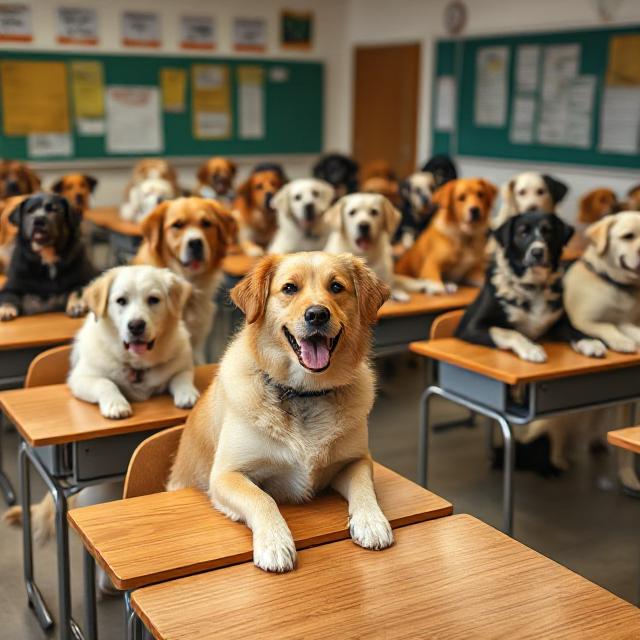
I work with dogs for a living. A lot of dogs. Usually in the range of 100 per week. I spend an inordinate amount of time together in large groups and it’s really fun to watch the socialization of the group as they pick out friends and learn how to play together. I once read a study that compared dogs social skills and learning ability to that of a toddler and as such I have worked hard to treat them accordingly. I have also had great success with training and behavior control when treating the dogs more like children, setting boundaries and working within their level of understanding as opposed to trying to simply make them obey.
My spouse on the other hand, is a teacher and has spent many wonderful years in the elementary school system helping shape the young minds of tomorrow. One evening I was talking about one of the silly things I had said to a dog and she exclaimed “I’ve said that to my students too!”. This of course has lead to several very entertaining chats on the similarities between young children in class and our dog groups out on a hike.
Some expressions that we use are direct crossovers and their meanings leave very little room for doubt as to what’s happening.
“Did you just pee?” Is a question that can be directed at either a child or a dog at any time, with obvious meaning.
“Whats in your mouth?” And “Dont eat that!” are outbursts that are closely related to each other and are often used in conjunction. It is however considered slightly more acceptable to physically pry something out of a dogs mouth as opposed to a child’s mouth.
Some of the less common sayings we discovered an overlap of between teaching and dog handling can sound a little strange when heard out of context. These include things like:
“Let her have it, there are enough sticks for everyone.” When either group is in the forest, someone will invariably determine that one stick is the SUPREME stick and it must be defended at all costs, up to and including a physical altercation. Trying to convince someone that a lesser stick is equally attractive is usually a futile battle.
Sibling rivalries is a noteworthy but expected dynamic with both children and dogs. The fact that we have both used the phrase “Stop eating your sister” come as more of a suprise.
“Are your ears just for decoration?” or any other phrase to denote the lack of listening ability is also very common between both groups that we interact with.
Of course there will always be a rebel who holds up the entire class: “Ok everybody has to wait. We can’t go until Stanley joins the group.”
More often than anyone would care to admit, we all know who “Stanley” is going to be on any given adventure. We can tell.
“Get in the van” and “get on the bus” are virtually interchangeable along with “I hope everyone went pee before we left”. Whether it’s a dogs wilderness adventure or a child’s school field trip, someone always has to pee five minutes into the journey.
As we head off for our days adventure we can’t help but notice that some parents of either children or dogs have over packed, with lunches perfectly measured out and tagged with the students or dogs names. They often send extra treats as well, with some sending enough “for the whole class”. Other parents might send a used plastic bag full of unrecognizable food, with the top knotted shut. We both keep extra food on hand for those who are sent without.
Both my teacher spouse and myself have to deal with multiple pupils with he same name. She has several ways of dealing with this, including approved nicknames or perhaps using a middle name to differentiate the students. With dogs we have the luxury of just referring to a physical trait tied to their name. For example, we may refer to “Brown Callie” versus “Spotted Callie” with my dogs. This is not a socially acceptable way for her to refer to children.
On a more serious note, there is also a very strong overlap found in the effects of their home life on their daily behavior. If there’s a major change at home, we know. Breakups, new relations, new baby, a serious illness – every teacher knows when something has changed in the homelife of a student. We do too. A dogs behavior can change drastically if their schedule/routine/circle of people changes. I can see a dog acting out or behaving out of character and have a pretty good idea when there is some kind of conflict or major change in their life. Like children, dogs can really wear their heart on their sleeve.
One final point that isn’t talked about a lot but is worth noting to anyone considering a career in either elementary school teaching or dog handling: You will deal with more poop than you ever imagined. I promise.

Buy me a coffee
If you are enjoying this blog please consider donating to help me stay caffeinated
CA$5.00
 The Involved Husband